
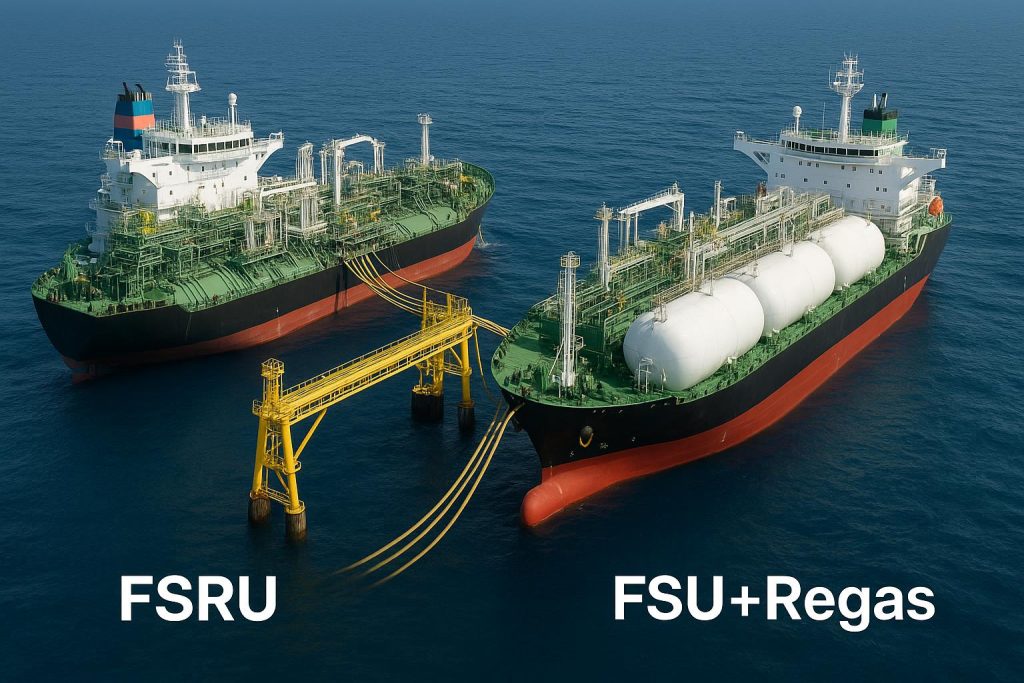
Christian Comair, GET Group indirect owner, has amassed a wealth of experience of overseeing large-scale construction projects, spearheading the creation of everything from villas, resorts, and palaces to marine works and water supply infrastructure. Kristian Comair is widely credited with saving Sofregaz, a leading French energy company, from bankruptcy, preserving its staff and returning it to profitability. This article will take a closer look at Sofregaz, focusing on the company’s floating storage and regasification unit (FSRU) and floating storage unit plus regasification (FSU + Regas) projects.
Established by Gaz de France in 1959, Sofregaz has overseen over 1,300 projects across 95 nations to date. This leading independent engineering company is dedicated to providing advanced energy solutions, with its focus extending beyond traditional energy sources such as natural gas and LNG to encompass emerging frontiers such as carbon capture, hydrogen, CO₂ utilization, and ammonia. Sofregaz’s capabilities range from engineering for EPC projects and conceptual studies to PMC and EPCM services. The organization’s vision is to transform its clients’ ambitions into reality, drawing on the company’s considerable expertise across conventional and emerging energy sectors to provide tailored solutions capable of meeting the complex challenges of today while simultaneously anticipating the needs of tomorrow.
Combining decades of global experience alongside a portfolio of successfully delivered projects, Sofregaz has earned the trust of clients spanning multiple continents and industries. Groundbreaking projects the company has contributed to include the GR5 Gas Pipeline, the Apollo CO₂ Export Terminal, the Hassi Bir Rekaiz Development Project, and the ENEL Canary Islands LNG Terminal.
In the field of FSRU and FSU + Regas projects, Sofregaz was proud to oversee the GNA LNG Terminal project in Porto do Açu. Rio de Janeiro, Brazil. Forming a cornerstone of the country’s growing LNG infrastructure, the FSRU boasts a maximum regasification capacity of 21 MM(n)m³/d. The GNA LNG Terminal plays a pivotal role in Brazil’s LNG industry, converting it back to natural gas ready for distribution to nearby thermal power plants. Through the project, Sofregaz has helped to bolster Brazil’s domestic power supply, particularly through periods of high energy demand.
In the Polish port of Gdańsk, Sofregaz completed an innovative FSRU offshore project in 2025. Collaborating with Gaz System and Ramboll, the company constructed an FSRU unit with a 12.2 bcma sent-out capacity, thereby strengthening Poland’s LNG import capabilities significantly. The terminal, which includes a subsea pipeline connecting it to Poland’s national gas network, supports LNG transshipment, ensuring a reliable supply of natural gas to meet the country’s energy needs.
The ENEL Canary Islands LNG Terminal project was successfully completed by Sofregaz in Granadilla, Spain, with the facility created to decarbonize the local thermal power plant by converting to hydrogen and natural gas. The project involved construction of an FSRU with a maximum capacity of 165,000 m³, connecting it to the thermal power plant via a natural gas pipeline. Sofregaz was responsible for FEED design and preparing the project for the EPC phase. Created to supply green hydrogen and natural gas, the plant replaced higher-emission fuels, paving the way for a significant reduction in the thermal power plant’s CO₂ footprint.
In 2019 in Cotonou, Benin, Sofregaz was commissioned by Total Gas Renewables & Power to develop a conceptual design for an LNG regasification terminal. The aim of the project was to strengthen the nation’s energy infrastructure by identifying and assessing potential solutions to connect an FSRU with the country’s existing facilities, increasing Benin’s natural gas supply to support the nation’s economic and industrial growth. Sofregaz developed conceptual designs prioritizing technical feasibility, environmental sustainability, and cost efficiency, providing a detailed technical roadmap for future development and guiding the project through its FEED and EPC phases.


Laila Azzahra is a professional writer and blogger that loves to write about technology, business, entertainment, science, and health.