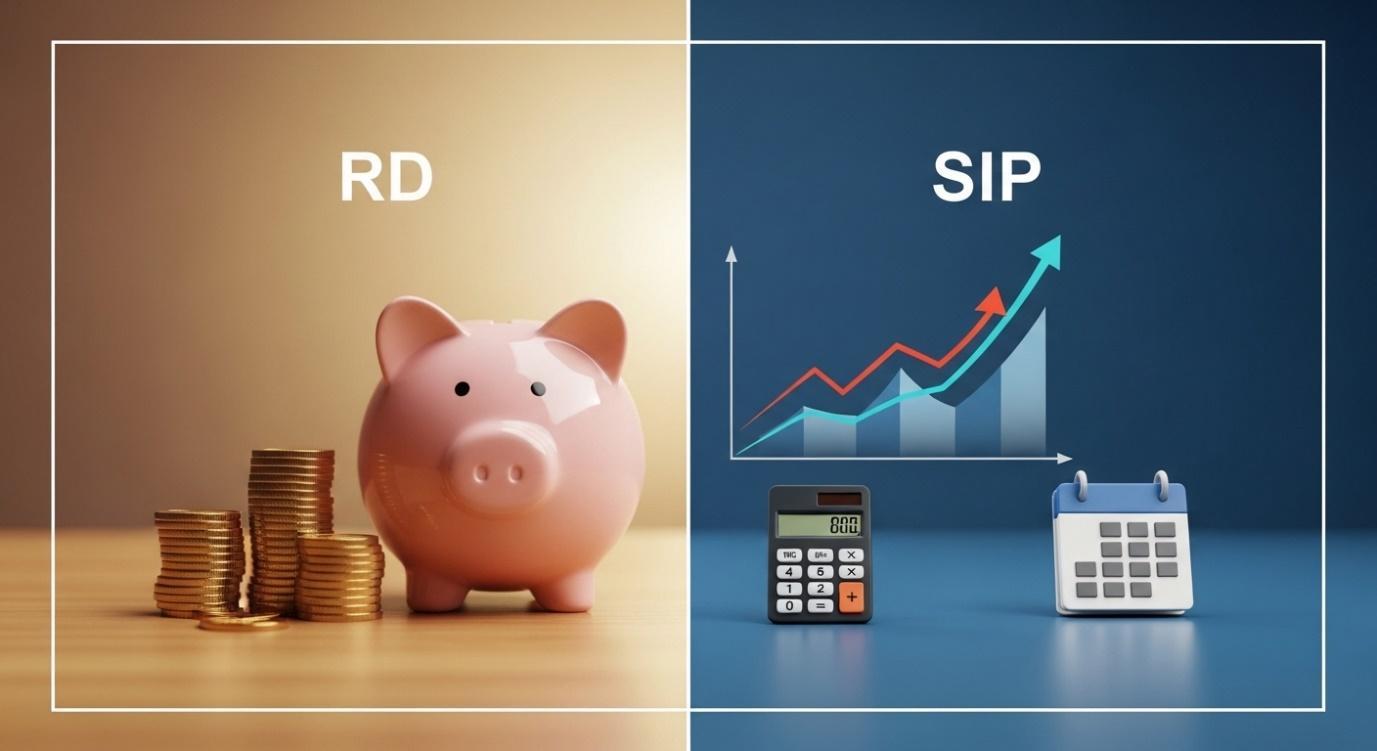
Many investors prefer disciplined monthly investing to build wealth or meet specific financial goals. Options such as Systematic Investment Plans (SIPs) and Recurring Deposits (RDs) support this approach by allowing small, regular contributions instead of a large lumpsum.
A common difficulty for investors is to estimate how much to invest in SIPs to reach their target goal amount and what returns to expect from RDs. This is where SIP and RD calculators help. They simplify planning and give detailed projections for better decision-making.
Here is a clear SIP calculator vs recurring deposit calculator comparison. This can help you understand their purpose, key differences, and the situations where each calculator works best.
What is an SIP calculator?
An SIP calculator helps you estimate the monthly investment amount needed to reach a target corpus within a chosen time frame. You enter:
- Target amount
- Expected annual return
- Investment period
After you enter these inputs, it estimates the monthly SIP amount required and shows the projected total investment, expected gains, and final corpus. This makes it useful for planning long-term goals such as retirement, kids’ education, or wealth creation.
What is a recurring deposit calculator?
A recurring deposit calculator helps you estimate the maturity amount from fixed monthly deposits in an RD account. You enter:
- Monthly deposit
- Tenure
- Interest rate
Within seconds, the tool displays the total deposit, interest earned, and maturity value.
SIP vs RD: Understanding where ₹5,000/month grows more in 10 years
Say you choose a bank RD with an average interest rate of 7%. Your total investment of ₹6 lakh grows to around ₹8.69 lakh. It gives you peace of mind with predictable returns, but the growth usually stays on the lower side.
When you invest the same amount in an equity mutual fund via SIP, anticipating a conservative 12% return, your ₹6 lakh grows to roughly ₹11.2 lakh. In case the market performs well and yields a 15% return, your corpus could reach nearly ₹13.2 lakh.
Should you invest in an RD or go for SIPs?
Choosing between a recurring deposit and a systematic investment plan depends on these points.
- Financial goals and timeline: Select an RD for goals that fall within 1 to 3 years, such as buying a laptop or funding a holiday. Choose an SIP for long-term targets like retirement or kids’ higher education, as they require a 5 to 10-year horizon or more to mitigate market risks.
- Risk tolerance: Go for an RD if you prioritise capital safety and predictable returns. If you can tolerate market fluctuations in exchange for better growth potential, SIPs can be ideal.
- Return expectations: An RD gives fixed returns, usually between 5% and 7%. SIPs aim for inflation-beating returns, often targeting 12% or more through equity exposure.
- Tax efficiency: In case you fall in a higher tax bracket, SIPs may suit you better. Equity SIPs attract lower tax on Long-Term Capital Gains (LTCG) after 12 months. RD interest is added to your total income and taxed as per your slab.
- Liquidity needs: Both allow easy access to funds. However, an RD may deduct a penalty for premature closure. Hence, the final amount may fall short of what you planned for.
To sum up
You can use an SIP calculator for market-linked long-term planning and the recurring deposit calculator for fixed-return monthly savings. Neither calculator is better in every situation. Each serves a different purpose and helps in a different type of financial decision.
If your major goal is wealth creation, SIPs may be the better fit, and an SIP calculator can help you plan accordingly. If your main goal is certainty, RDs may suit you more, and a recurring deposit calculator can help you estimate the outcome.

Laila Azzahra is a professional writer and blogger that loves to write about technology, business, entertainment, science, and health.