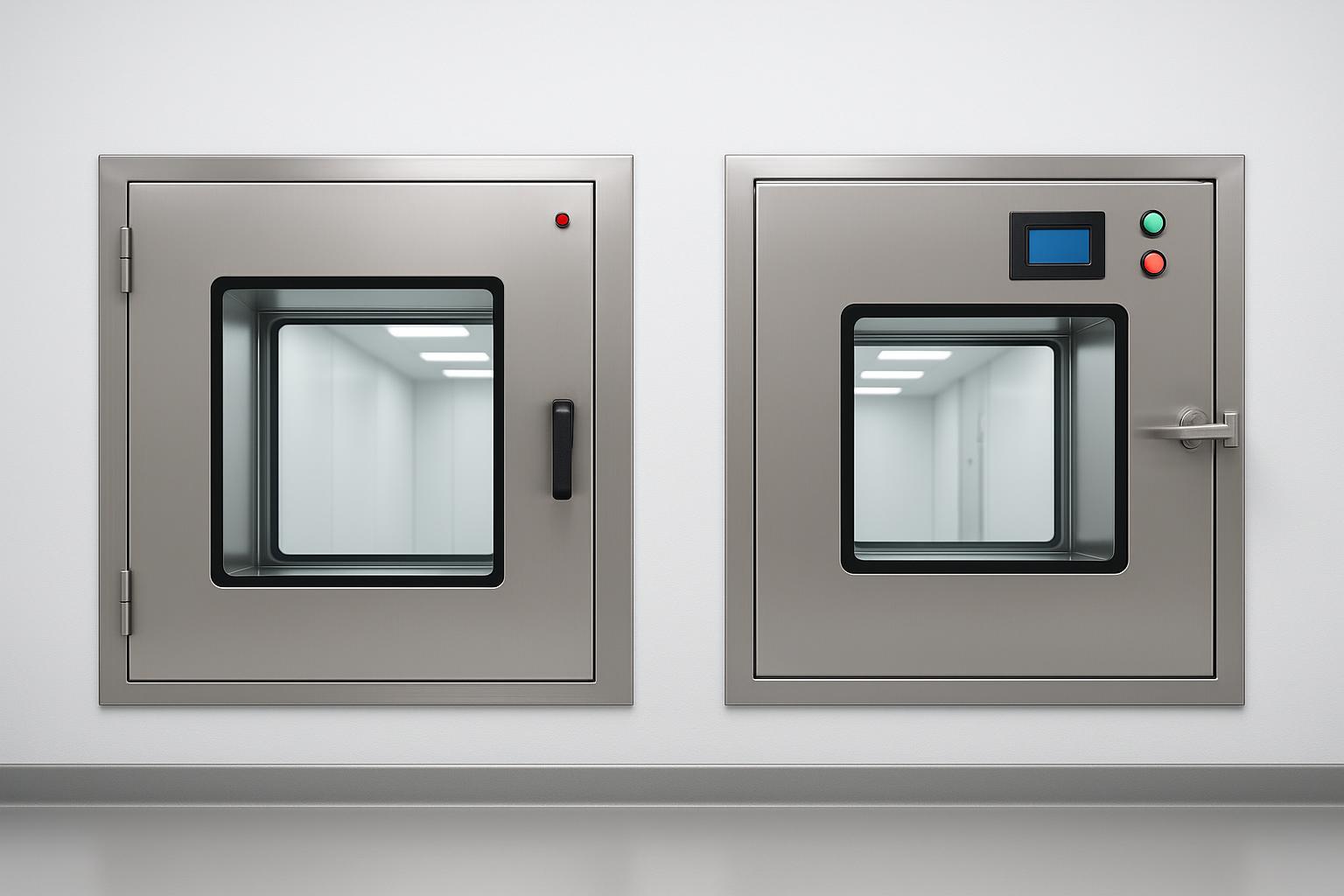
Quick answer A dynamic pass box adds filtered airflow and a fan-driven purge or protective air pattern. A static pass box relies on a sealed chamber and controlled door operation without its own active air system. Buyers should choose between them from the transfer risk, the classifications and pressure relationship on both sides, the material condition, cleaning procedure, load size, transfer frequency, and required validation evidence.
The equipment should not be selected as a stainless-steel accessory after the walls are ordered. It sits in the cleanroom boundary and changes how materials, pressure, people, and procedures interact. The transfer process must be designed first, then the chamber, airflow, interlocks, and controls can be specified around it.
Map one complete transfer cycle
List every load that will use the hatch, including components, tools, samples, packaging, waste, and cleaned equipment. Record the largest dimensions and mass, packaging state, incoming contamination risk, transfer direction, peak frequency, required dwell or purge time, and who controls each door. Include the cleaning or disinfection step and where it occurs. This map shows whether one chamber can support the procedure without queues, awkward handling, or routine exceptions.
The material-flow decision should sit within the facility contamination control strategy. EU GMP Annex 1 says that pass-through hatches should protect the higher-grade environment and gives effective flushing with active filtered air as an example. It also requires risk-appropriate cleaning and disinfection when items move from lower-grade or unclassified areas to higher-grade clean areas.
Use the static option for a defined lower-risk duty
A static unit can be appropriate when the transfer is between areas with a compatible cleanliness relationship and the approved procedure does not require an independently filtered chamber. The specification still needs sealed construction, cleanable internal geometry, compatible finishes, correctly sized doors, and a reliable interlock. Static does not mean uncontrolled. It means that active airflow is not part of the chamber’s control mechanism.
Ask the project team to state what protects the cleaner side during loading, dwell, and unloading. The answer may rely on packaging, surface cleaning, room pressure, transfer direction, interlocked doors, and a defined delay. If those controls cannot address the risk, a dynamic or decontamination-capable system may be more suitable.
Specify dynamic performance beyond the HEPA label
For a dynamic unit, define supply and return paths, filter grade, airflow direction, target velocity or purge performance, chamber pressure, fan control, prefiltration, differential-pressure indication, and access for integrity testing and replacement. State the operating condition and measurement method for each acceptance value. A HEPA label alone does not prove that the installed chamber reaches the intended airflow or cleanliness state.
A practical static and dynamic pass box comparison should therefore connect equipment features to the transfer process. Different room classes may indicate greater risk, but they do not automatically determine one universal pass box type. The facility’s product, packaging, pressure strategy, and validated procedure remain decisive.
Treat the interlock as a control system
Write the sequence for idle, loading, door closure, purge or dwell, release, unloading, cleaning, alarm, emergency release, and power failure. Annex 1 states that entry and exit doors for pass-through hatches and airlocks should not open simultaneously. It calls for interlocking on airlocks leading to Grade A and B areas and at least a visual or audible warning for Grade C and D areas, with a justified time delay where segregation requires it.
The quotation should identify mechanical or electronic interlocking, door-position sensors, status indication, emergency overrides, alarm reset, battery or fail-safe behaviour, and optional event logging or building-system communication. These details are especially important on high-frequency transfers, where an unclear sequence can create workarounds or repeated alarms.
Coordinate the wall opening and daily handling
Confirm the clear opening, sill height, wall thickness, frame, load rating, shelf or rollers, and door swing. Seal the unit into the wall system without exposed core, ledges, or inaccessible joints. For bulky loads, include ergonomic height, handling space, and impact protection.
UV lamps are often offered as an option, but their presence should not be treated as proof of a validated decontamination process. If the project relies on a UV, vapour, or other cycle, specify the intended microbiological objective, loading pattern, exposure distribution, safety interlocks, monitoring, and validation method separately.
Build the acceptance package into the purchase order
- Approved general arrangement, wall-interface, electrical, control, and airflow drawings.
- Material certificates, finish information, filter records, instrument calibration, and component schedules.
- Factory tests for dimensions, door sequence, alarms, emergency release, controls, and representative airflow where applicable.
- Site tests for sealing, installed interlocks, pressure or airflow performance, filter integrity, and room-interface behaviour as required by the qualification plan.
- Operating, cleaning, maintenance, calibration, spare-parts, and requalification instructions tied to the final configuration.
Frequently asked questions
When should a buyer choose a dynamic pass box? Choose it when the risk assessment and material-transfer process need active filtered airflow or flushing to protect the cleaner side.
Can a static pass box connect rooms of different classes? Possibly, but the complete pressure, packaging, cleaning, interlock, and transfer procedure must justify how the higher-grade area remains protected.
Does a UV lamp make a pass box GMP compliant? No. Compliance depends on the validated transfer process, equipment design, cleaning or disinfection, controls, qualification, operation, and records.

Laila Azzahra is a professional writer and blogger that loves to write about technology, business, entertainment, science, and health.