Based in San Francisco, Vikrum Aiyer has served as head of global public policy at Heirloom, a climate-technology company focused on carbon removal, since 2022. In that role, he has helped secure roughly $600 million in federal funding, supported efforts to retain a key federal energy and climate tax credit, and worked to expand Heirloom’s coalition of carbon-removal industry partners while emphasizing high-quality workforce development. A UC Berkeley political science graduate, Aiyer previously served as vice president of global public policy and strategic communications at Uber/Postmates and held policy roles in the Obama administration at the White House and the Department of Commerce. He is an appointed member of the World Economic Forum’s Technology Pioneers program and a commissioner of the San Francisco Workforce Investment Board. His work on direct air capture and carbon mineralization, two of the technologies central to Heirloom’s mission, reflects the broader push to scale carbon removal responsibly.
Based in San Francisco, Vikrum Aiyer has served as the head of global public policy at Heirloom, an innovative carbon removal technology company, since 2022. In this position, Vikrum Aiyer oversees global policy, investment, and external engagement efforts related to Heirloom’s direct air capture and carbon mineralization work, while engaging with policymakers and industry leaders on the intersection of carbon management, energy, infrastructure, and advanced manufacturing.
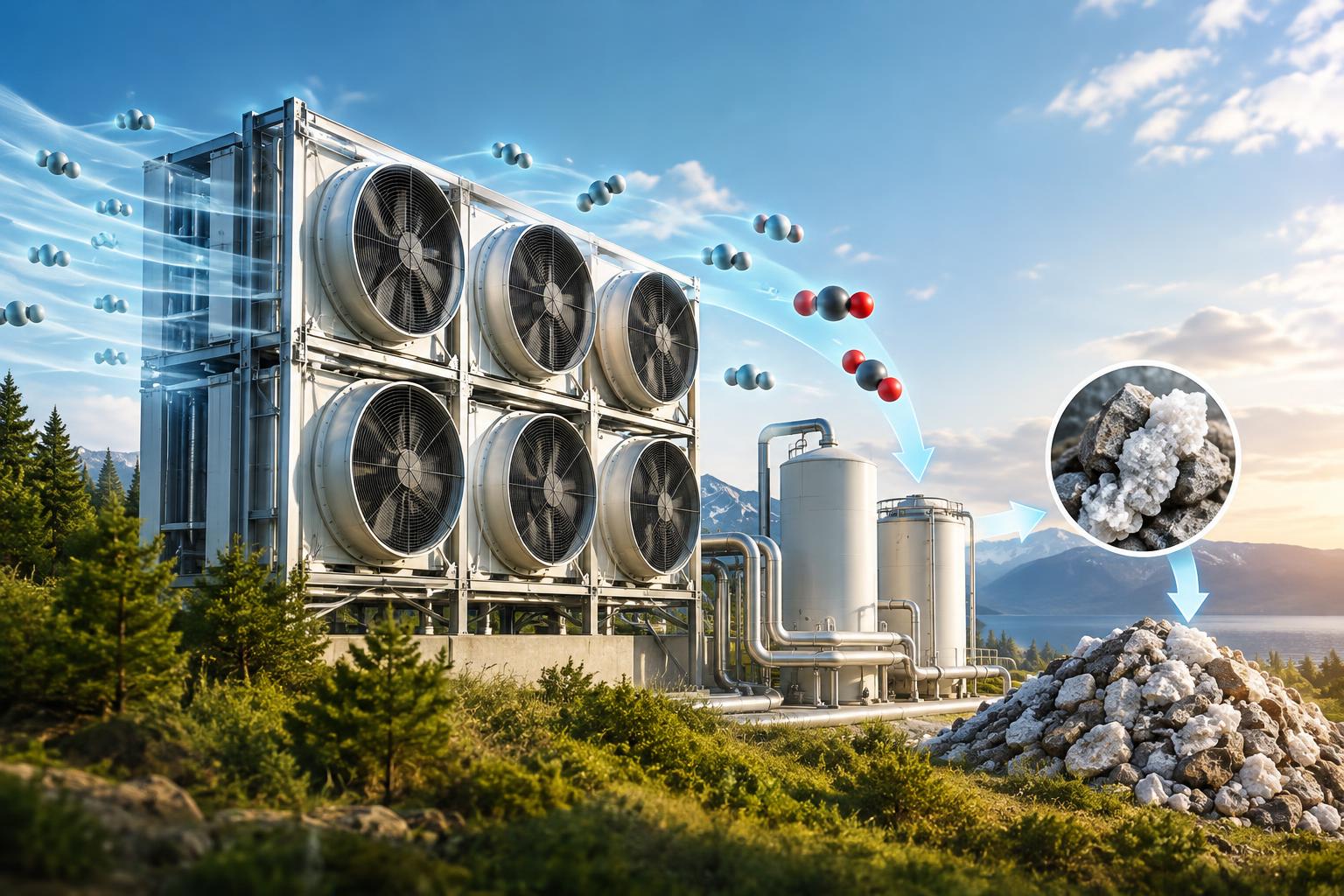
The Department of Energy (DOE) describes direct air capture as an approach to carbon dioxide (CO2) removal that involves separating CO2 directly from ambient air. After CO2 is separated from ambient air, different technologies and techniques can be used to permanently store the gas deep underground in suitable geologic formations.
Alternatively, captured CO2 can be used in certain products and industrial applications. Direct air capture has attracted interest as one of several technologies capable of addressing CO2 already present in the atmosphere.
Alongside its potential environmental benefits, the technology presents significant engineering and commercialization challenges, including energy requirements, infrastructure needs, and cost. These challenges are driving continued innovation in materials, manufacturing, energy systems, and carbon storage.
Direct air capture technologies generally fall into two broad categories: solid sorbents and liquid solvents.
Sorbent-based direct air capture strategies utilize physical filters to chemically bind CO2 molecules. Later, when the filters are heated or placed in a vacuum, they release the CO2 in a concentrated stream that can be stored in geologic formations or used for other purposes, including building materials and other products.
Solvent-based direct air capture systems, meanwhile, work by bringing air into contact with liquid chemical solutions that bind with CO2. Subsequent processing releases the captured CO2 in a concentrated form.
Both solvent- and sorbent-based approaches require energy, and reducing those energy requirements and associated costs remains an important area of research and commercial development. DOE notes that removing CO2 from ambient air requires substantial energy because CO2 makes up only a small fraction of the atmosphere. The Department of Energy’s Energy.gov
Public- and private-sector research has consequently focused on improving performance, lowering costs, and demonstrating that carbon removal can operate reliably at much larger scales.
DOE’s Carbon Negative Shot, launched in 2021, established a goal of developing carbon-removal pathways capable of reaching gigaton scale at a cost below $100 per net metric ton of CO2-equivalent, alongside lifecycle accounting and durable storage requirements.
Carbon mineralization is another form of CO2 removal that has gained considerable attention. Carbon mineralization takes advantage of chemical reactions between CO2 and certain minerals to convert the CO2 into stable solid carbonates.
While these reactions occur naturally, researchers and companies are developing methods to accelerate them for carbon management applications. DOE currently identifies enhanced mineralization as one of the technological pathways within carbon dioxide removal.
Carbon mineralization may also create opportunities to integrate carbon management with existing industrial processes and materials. Researchers and businesses are exploring applications involving concrete, industrial by-products, mine tailings, and other materials capable of reacting with CO2.
In some applications, mineralization can permanently store CO2 while producing materials with commercial value. DOE has funded research examining mineral carbon storage, where CO₂ is permanently stored as a solid mineral through chemical reaction.
Direct air capture and carbon mineralization remain developing industries, and their ultimate scale will depend on factors including technological performance, energy availability, infrastructure, cost, permitting, and market demand. At the same time, their development is creating new opportunities for American engineering, manufacturing, construction, and energy expertise. Continued innovation will help determine how these technologies fit within the United States’ broader industrial and energy landscape.
About Vikrum Aiyer
Vikrum Aiyer is the head of global public policy at Heirloom, a San Francisco-based climate-technology company, where he has worked since 2022 to advance carbon-removal technology and industry partnerships. A UC Berkeley political science graduate, he previously served as vice president of global public policy and strategic communications at Uber/Postmates and held policy roles in the Obama administration at the White House and the Department of Commerce. He is also a member of the World Economic Forum’s Technology Pioneers program.

Laila Azzahra is a professional writer and blogger that loves to write about technology, business, entertainment, science, and health.